Prepare the field like this before sowing in pea farming

Prepare the field like this before sowing in pea farming

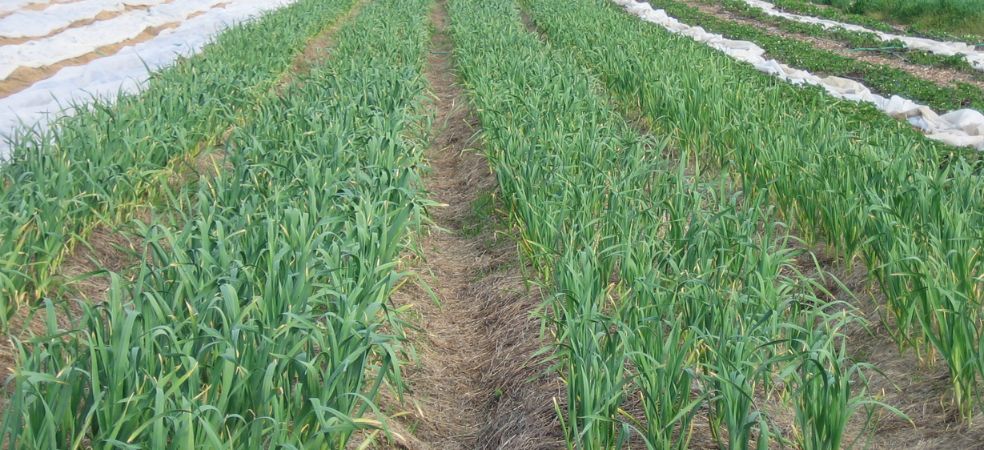
Pea farmers should start preparing the field for the sowing of pea seeds 10 days before sowing.

For preparation, mix the following manure and fertilizers and mix them in the soil.

  • Manure – Apply 4 tons of cow dung manure + 4 kg composting bacteria (speed compost) per acre of soil.

  • Fertilizer and Other Nutrients – SSP Granular with Boron – 150 kg + Urea 35 kg + MOP 10 kg + Consortia of PK Bacteria (Pro Combi Max) @1 kg + Rhizobium (Bio Vatika R) @1 kg + Trichoderma viridi (Rhizocare) @ 500 gm + Sea Algae, Amino, Humic (Tri-Coat Maxx) @ 4 kg + Magnesium Sulphate 5 kg per acre.

For such important information related to the agriculture sector and farmers, do read Gramophone articles daily. If you liked today’s information then don’t forget to share.

Share

There are many benefits of treating seeds before sowing

There are many benefits of treating seeds before sowing
  • Seed treatment is important to protect seeds and seedlings from diseases and pest pressure during planting. There are hundreds of pathogens and insects that can damage or even kill seeds or seedlings before they develop.

  • It can negatively impact crop progress throughout the growing season and have a significant impact on yield results at harvest time. It is effective in preventing the spread of both systemic and non-systemic plant diseases.

  • Effective in preventing the spread of both systemic and non-systemic plant diseases. Protects seeds from seed rot and plant blight. Once the seed is planted, the protective coating around the seed acts as a barrier against seed-borne and soil-borne organisms.

For such important information related to the agriculture sector and farmers, do read Gramophone articles daily. If you liked today’s information then don’t forget to like and share.

Share

FIR method of seed treatment is very beneficial for crops

FIR method of seed treatment is very beneficial for crops

Seed treatment with fungicides, insecticides and Rhizobium is recommended to boost productivity. The recommended fungicides- Insecticides-Rhizobium (FIR) sequence for seed treatment should be followed. Seed treatment with fungicide is important for limiting the incidence of seed-borne and soil-borne diseases, like management of wilt and root rot diseases, For management of insects in soils, treat the seed with insecticide.

Seed treatment with Rhizobium strains is recommended for better root nodulation. After seed treatment, allow the seeds to dry in the shade before sowing. Avoid drying of treated seeds in direct sunlight. Preferably, seed treatment should be performed during the evening and sowing should be done during morning hours.

For such important information related to the agriculture sector and farmers, do read Gramophone articles daily. If you liked today’s information then don’t forget to like and share.

Share

Three methods of sowing onion, know which method is best?

Three methods of sowing onion know which method is best?

At present many farmers are planning to cultivate onion. Do you know that sowing work in onion cultivation can be done in three ways? Let us know the main information about these three methods one by one.

  • Direct sowing of seeds: This method of onion sowing is used in sandy soil. In this method, the soil is prepared properly and the seeds are left in the field. In this method, the quantity of seeds is kept at 4-5 kg per acre.

  • Planting onions from nodes: In this method of sowing, onions are prepared by sprouting them in advance. Small onion bulbs are planted. Onions are planted at the rate of 4-5 quintals per acre.

  • Preparing seedlings from seeds and planting them in the field: This is the most commonly adopted method of onion cultivation. Through this, onion seeds are first sown in the nursery and then its seedlings are planted in the main field.

For information related to agriculture and farmers, read the articles of Gramophone daily. Don’t forget to share this article with your friends using the share button below.

Share

Root rot and damping off of cowpea crop

Root rot and damping off of cowpea crop
  • Due to the outbreak of diseases, the seedlings remain small and some of these seedlings rot in the hypocotyl region and spread downwards.

  • Due to this, the roots also start rotting and the plants start drying up.

  • Brown-black sunken lesions appear on the lower stems of mature plants, and small black sclerotia accumulate in the roots.

  • Due to this, sometimes the girdle of the stem may break longitudinally.

  • To avoid its outbreak, adopt crop rotation with non-host crops for 2-3 years.

  • Seed treatment with Treating seeds with Carmanova (Carbendazim 12%+ Mancozeb 64%) @ 3 gm/ kg seeds before sowing.

For information related to agriculture and farmers, read the articles of Gramophone daily. Don’t forget to share this article with your friends using the share button below.

Share

Attack of leaf miner in Ridge gourd

Attack of leaf miner in Ridge gourd
  • Its adult is a light yellow fly that lays eggs on the leaves.

  • White zigzag lines are formed on the leaves and leaves dry out and fall when there is more outbreak.

  • Fruiting problems are seen in plants affected by this insect, which reduces the yield

  • Remove the weed from the field and its surroundings.

  • To prevent this, spray Clorida (Imidacloprid 17.80% S.L) @ 40 ml/ acre or Benevia(Cyantraniliprole 10.26 % OD) 360 ml/acre.

For information related to agriculture and farmers, read the articles of Gramophone daily. Don’t forget to share this article with your friends using the share button below.

Share

Use of Decomposers after soybean harvesting

Use of Decomposers after soybean harvesting
  • After harvesting the soybean crop, crop residues remain in the field in huge quantities.

  • These residues can cause high rates of fungal and bacterial disease infection in the next crop.

  • Due to this reason,  the new crop is affected by root rot, stem rot, etc. diseases. 

  • After soybean harvesting, it is very important to use decomposers either in an empty field or after sowing the crop to control these fungal and bacterial diseases. 

  • To avoid this the farmer can use liquid decomposers at the rate of 1 litre per acre by the means of spraying.

  • Apart from this, Gramophone provides a brand of decomposer to the farmers known as speed compost, usage is 4 kg of speed compost per acre combined with 10 kg of urea, mix this combination in 50-100 kg of soil and broadcast in the field. 

  • Make sure that there is enough moisture in the field while using this decomposer.

For information related to agriculture and farmers, read the articles of Gramophone daily. Don’t forget to share this article with your friends using the share button below.

Share

Stem fly infestation will be fatal for soybean crop

Stem fly infestation will be fatal for soybean crop
  • The Main Causes For Stem Fly/Stem Borer In Soybean Crop Are Very Dense Sowing Of The Crop, Inappropriate Use Of Pesticides, Non-Adoption Of The Crop rotation.

  • The Most Important Thing For The Control Of Stem Fly In Soybean Crops Is Appropriate Control In The Early Stage Of The Infection Of The Caterpillar.

  • A Spray Of Beauveria Bassiana Periodically Is Very Important To Control of the Stem Fly.

A Spray Of The Following Products Is Crucial For The Control Of Stem Fly In The Soybean Crop.

  • Thionova (Thiamethoxam 25% Wg) @ 100 Gram / Acre + Denitol (Fenpropathrin 10% Ec) @ 400 Ml / Acre.

  • Or Thionova (Thiamethoxam 25% Wg @ 100 Gram / Acre + Bave Curb (Beauveria Bassiana) @ 250 Gram / Acre.

  • Or Fipnova (Fipronil 5% Sc) @ 400 Ml / Acre Or Denitol (Fenpropathrin 10% Ec) @ 400 Ml / Acre +Bave Curb (Beauveria Bassiana) @ 250 Gram / Acre.

For more such important information related to the agriculture sector, keep reading the articles of Gramophone daily. If you liked today’s information, then do not forget to share it with friends.
Share

Soybean will be harmed by Gram pod borer, take immediate precautions

Soybean will be harmed by Gram pod borer
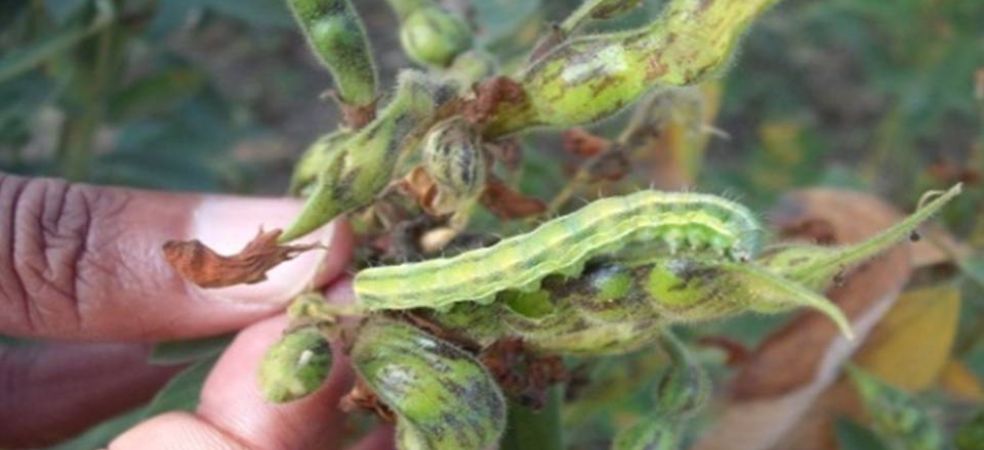
  • The larvae feed on all plant parts but prefer to eat flowers and beans.

  • The black hole appears on the affected pod and larvae appear hanging out of the pod while eating.

  • The tiny larvae feed the chlorophyll by scratching of leaves, which causes the leaves to become skeletal.

  • In the severe stage of infection, the leaf falls down and the plant dies.

    Management of Gram Pod Borer in Soybean:-

  • To control adult pests, use a pheromone trap @ 8-10/acre.

  • First, spray Profenova (Profenofos 50% EC) @ 300 ml/acre + Tricel (Chlorpyrifos 20% EC) @ 500 ml/acre.

  • Second Spray Profenova super (Profenofos 40%EC + Cypermethrin 4 %EC) @ 400 ml/acre + Emanova (Emamectin benzoate 5% SG) @ 80-100 gm/acre.

  • Third spray Ampligo(Chlorantraniliprole 9.3% + Lambda Cyhalothrin 4.6% ZC)@ 100 ml/acre or Larvin (Thiodicarb 75% WP) @ 250 gm/acre.

  • Spray the Bave Curb (Beauveria bassiana) @ 250 gm/acre as a biological treatment.

For more such important information related to the agriculture sector, keep reading the articles of Gramophone daily. If you liked today’s information, then do not forget to share it with friends.
Share

Management of Fruit borer in chilli

Management of Fruit borer in chilli
  • A circular hole is noticed at the base of the pedicel—the premature dropping of flowers and pods. The fruit turns to white colour.

  • Mainly borer larvae have grown up into the fruits.

  • Early instar larvae by making a circular hole feed on young pods and flower buds. The larvae usually feed the seeds in mature fruit.

  • At the time of feeding the larvae head inside the pod and the rest of the body outside from fruits.

  • To control adult pests, use a pheromone trap @ 8 -10 /acre.

  • First spray Profenova(Profenofos 50% E.C.) @ 300 ml/acre + Tricel (Chlorpyrifos 20% EC) @ 500 ml/acre.

  • Second Spray Profenova (Profenofos 50% EC @ 300 ml/acre + Emanova (Emamectin benzoate 5% SG) @ 80-100 gm/acre.

  • Third spray Emanova (emacactin benzoate 5% SG) @ 80-100 gm/acre + Denitol (fenpropathrin 10% EC) @ 250-300 ml/acre.

  • Fourth spray Ampligo(Chlorantraniliprole 9.3% + Lambda Cyhalothrin 4.6% ZC)@ 100 ml/acre or Larvin (Thiodicarb 75% WP) @ 250 gm/acre.

  • The Bave Curb (Beauveria bassiana) @ 250 gm/acre as a biological treatment.

For more such important information related to the agriculture sector, keep reading the articles of Gramophone daily. If you liked today’s information, then do not forget to share it with friends.
Share